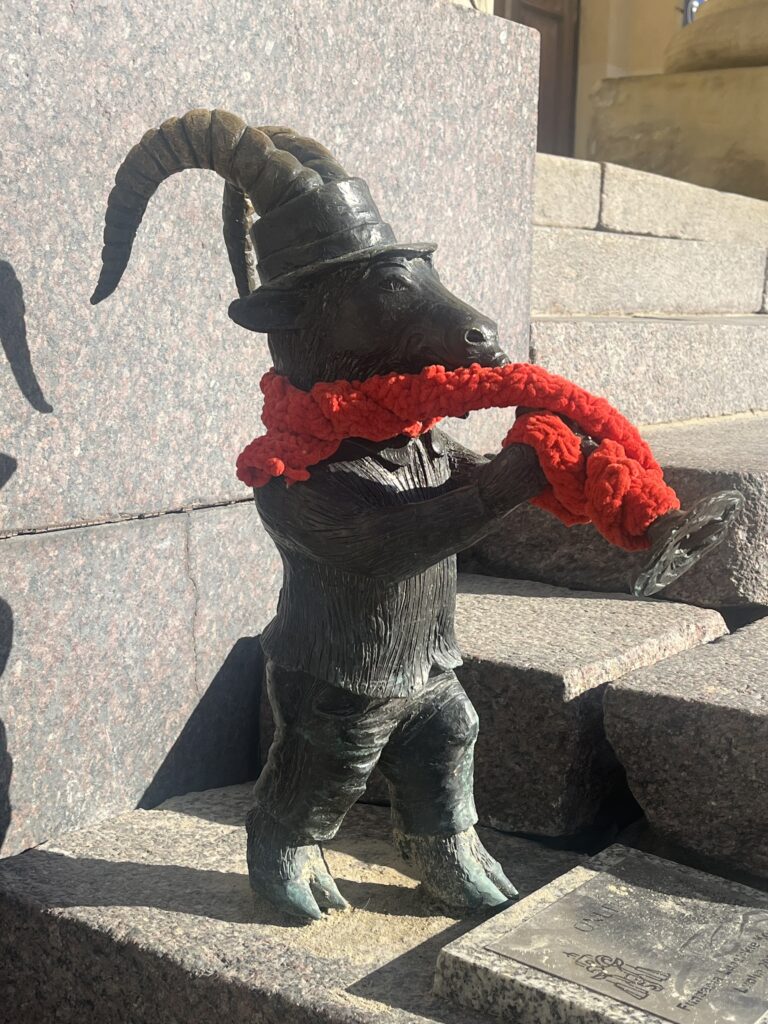
We are delighted to announce the first call for abstracts for the 15th Biennial Meeting of the Polish Association for Cognitive Science (PTK26), hosted by the Institute of Philosophy, Maria Curie-Skłodowska University in Lublin, from September 21 to 23, 2026.
The General goal
The meetings of PTK provide an opportunity to present research results of the Polish cognitive science community. These meetings aim to increase awareness of the scope of cognitive studies in Poland and to foster integration among Polish researchers. It is also an opportunity to engage in dialogue with the international cognitive science community. Accordingly, we invite all the scholars working on issues of philosophy of mind, philosophy of cognitive science, cognitive linguistics, cognitive semiotics, AI-related research, cognitive psychology, cognitive neuroscience, cognitive anthropology, and other cognition-related fields to present their ideas and results.
Conference topic:
Making sense of meaning-making
In addition to the above general goals, the Organizers aim to focus the attention of participants on specific topics and to initiate discussion on issues related to locally grounded research perspectives. As a result, inspired by the paper “Making Sense of Sense-Making” by Evan Thompson and Mog Stapleton, we particularly invite abstracts addressing the relationship between meaning-making and cognition. Accounts of meaning-making (semiosis) are focused on embodied subjects as embedded or even immersed in a physical and social environment, acting within these environments, experiencing them, engaging in intersubjective semiotic and linguistic interactions. Such a perspective shifts the emphasis from cognitivism to 4E (or even 5E) approaches. Accordingly, we especially encourage submissions that reflect upon the topic of multiple levels of meaning-making. Meaning-making can be considered a process rooted in biological life, which, in turn, is considered the foundation for emergent processes at the levels of subjectivity, intersubjectivity, sign use, and language. Such a framework raises questions about the boundaries between the layers mentioned above and about the possibility of crossing both the lower threshold of semiosis (life) and the upper threshold (language). Inquiries on varieties of meaning-making should be supplemented by methodological considerations; in particular, in particular, they should address the role (and balance) of first-person, second-person and third-person perspectives on cognition and meaning-making.
Topics
Topics for presentations include (but are not limited to):
- meaning-making and cognition
- consciousness and meaning-making
- phenomenological perspectives on meaning-making, lived experience, and cognition
- triangulation of first-, second-, and third-person methods in studies of meaning-making
- biosemiotics and meaning-making
- embodied meaning-making
- affect, emotions, and meaning-making
- making sense of the Other
- distributed and extended meaning-making systems
- meaning-making in social interactions
- the problem of artificial meaning-making
- meaning-making from an evolutionary perspective
- meaning-making as a developmental process
- comparative perspective on meaning-making and cognition
- meaning-making by means of gestures and language
- multimodal, multisensory and polysemiotic meaning-making
- multimodal narrativity
- multicultural communication
- intersemiotic translation.
The conference will be held in English and Polish.
Deadline for individual abstract submissions: May, 15th
If you wish to organize a theme session (4-6 papers), please contact the Organizing Committee. Deadline for theme session proposals April, 30th
All submissions will be subject to peer review by the Scientific Committee.
Notification of acceptance: June, 15th
Contact:
info@ptk26.umcs.lublin.pl
The Organizing Committee